WP8 SAREC iCP Training Course for EURAD-2
The interface Comsol PhreeqC, or iCP, is a reactive transport code that couples two standalone simulation softwares:
Comsol Multiphysics® is powerful general-purpose simulation software for modelling coupled physics systems. It has a very intuitive graphical user interface with flexible configuration options for the whole modelling workflow, from geometry generation to result visualization.
PhreeqC is perhaps the most widely used geochemical code in the scientific community and is distributed free of charge. The program is based on equilibrium chemistry of aqueous solutions interacting with minerals, gases, solid solutions, exchangers, and sorption surfaces, but it also includes the capability to model kinetic reactions with user-defined rate equations. The use of extensible chemical databases allows application of the reaction, transport, and inverse-modelling capabilities to almost any chemical reaction that is recognized to influence rain-, soil-, ground and surface water quality.
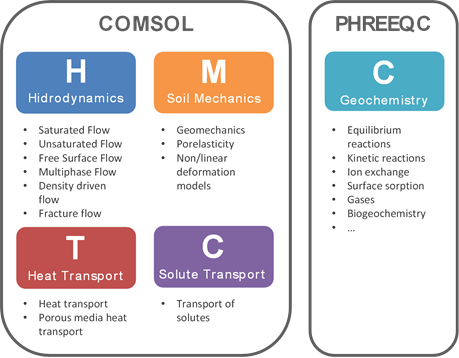
Figure 1‑1. Processes that can be simulated with Comsol Multiphysics and PhreeqC, and can be included in iCP models.
iCP maximizes the synergies between Comsol and PhreeqC, providing a numerical platform that can efficiently simulate a wide number of multiphysics problems coupled with geochemistry. It is written in Java and uses the IPhreeqc C++ dynamic library and the Comsol Java API. It also takes advantage of the multicore computer architecture by balancing the computational load over different threads. iCP is a powerful tool for those consultants or researchers who need to tackle coupled geochemical problems. The flexibility and wide applicability of iCP make it suitable for a large number of modelling challenges, which cover most of the needs of both industry and academia. iCP also considers couplings between chemical and physical processes, such as chemically-induced porosity changes and their impact on fluid flow and solute transport, or the effect of liquid saturation and temperature on geochemistry.
This proposal quantifies the efforts required to teach a 3-day iCP course in Barcelona, Spain, in April 2026. The course is aimed at instructing the participants in the basics of reactive transport, Comsol, PhreeqC and iCP through theoretical sessions and hands-on exercises.
The course instructors belong to the Amphos 21 modelling solutions group, which is included in the list of Comsol certified consultants (https://www.comsol.com/certified-consultants/amphos21).
It should be noted that Comsol and iCP are commercial softwares. Trial versions of the softwares will be provided for the course.