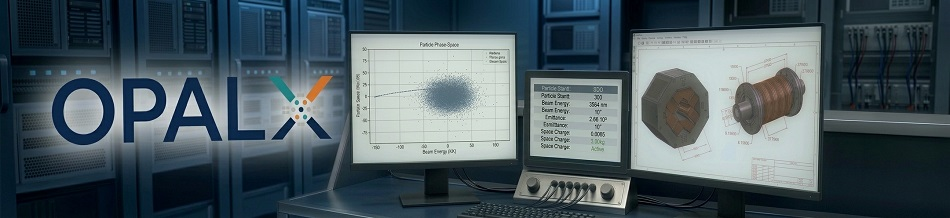
The accurate modeling of charged-particle beams is a central challenge in modern accelerator physics, requiring a tight integration of theory, experiment, and large-scale computation. In this context, high performance computing has emerged as a fundamental pillar, enabling detailed simulations that capture complex collective effects such as three-dimensional space charge.
OPAL (Object Oriented Parallel Accelerator Library) is a parallel, open-source framework specifically developed for charged-particle optics in both linear accelerators and circular machines. Built from the ground up as a high-performance application, OPAL leverages distributed computing architectures while remaining flexible enough to run efficiently on anything from a standard laptop to the largest supercomputing systems. Based on the MAD language with dedicated extensions, it provides a familiar yet powerful environment for accelerator modeling. Its modular C++ design further facilitates extensibility, allowing users and developers to incorporate new physics models and features with relative ease.
Building on this foundation, OPALX represents the next evolutionary step of the framework. It is a comprehensive rewrite aimed at achieving performance portability across modern heterogeneous computing architectures, including NVIDIA, AMD, and Intel GPUs. Designed with exascale computing in mind, OPALX maintains the core capabilities of OPAL—such as advanced charged-particle optics simulations with full 3D space charge—while extending its reach to emerging hardware platforms. Importantly, OPALX preserves a high degree of backward compatibility through continued use of the MAD language, with only minor differences that are carefully documented.
This event will provide an overview of OPALX, highlighting their capabilities, underlying design principles, and their role in advancing state-of-the-art accelerator simulations.
 |  |  |  |
 |  |  |  |
