Speaker
Description
The best angular resolution at visible and infrared wavelengths is currently achieved by using optical (phase) interferometers. However, OB stars are not ideal targets for these instruments: they are brighter at short wavelengths, where Michelson stellar interferometry becomes technically challenging, and their angular diameters are typically below the resolution of such interferometers. A new generation of optical intensity interferometers, well suited for observations in the blue band, is emerging by taking advantage of the existing infrastructure of Imaging Atmospheric Cherenkov telescopes.
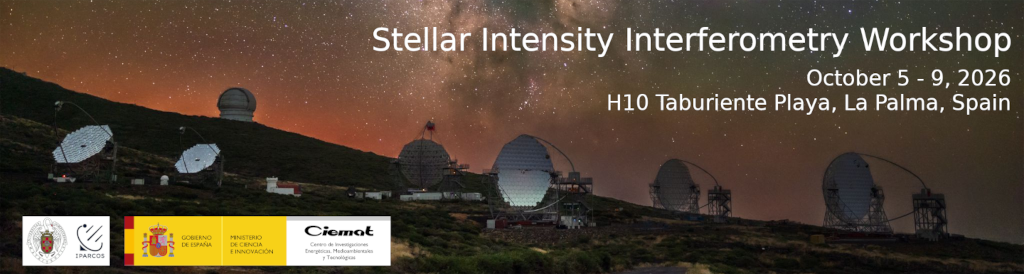
The MAGIC Stellar Intensity Interferometer (SII) was commissioned between 2019 and 2021, allowing routine observations during bright-Moon time, when very-high-energy observations are significantly affected by the moonlight. At the beginning of 2024, the first Large-Sized Telescope (LST-1) of the Cherenkov Telescope Array Observatory (CTAO) was incorporated into the array. The MAGIC SII is currently capable of resolving stars between 0.4 and 1.4 mas angular diameter and B=3 mag with 10% uncertainty in 2.5 hours. The MAGIC+LST-1 SII improves MAGIC SII sensitivity, allowing to perform equivalent measurements on 1 mag fainter targets in Blue band. Furthermore, the addition of the three remaining LSTs of the CTAO-North to the array will provide a similar boost in sensitivity in the future. To achieve this goal, the team is commissioning an extension of the present GPU-based correlator which will be capable of handling all input signals.
A number of projects have taken advantage of the unique capabilities of the MAGIC+LST-1 SII in recent years. Some of them focused on Be stars, including a study that measured the photospheric parameters of gamma Cassiopeiae. Other projects have used the MAGIC+LST-1 SII to characterize the orbits of spectroscopic binary systems as well as the corresponding stellar components. Furthermore, the angular diameters measured by this interferometer have been used to improve the predictions of asteroseismic models as well as the results of spectroscopic analyses. We will provide an overview of MAGIC+LST-1 SII observations and describe the upcoming improvements to the interferometer.
